Hello! This ended up sitting in my drafts for a while as I got busy with other things, so I’m publishing it although it is somewhat unfinished. Apologies.
It’s time to get into the digitization of our board game, The Search for The Mimir Code (Jakten på Mimirkoden).
This time I was not the acting team lead, rather I served mainly as the artist, and as a consultant as the only person on our team who had also worked on the physical version of our board game. As such, while I’ll talk briefly about the actual development, I will mainly be focusing on the art, the choices I made, mistakes, things I’m happy with, and things I would have done differently.
Inspiration and Aesthetics
My first challenge introduced itself early. While our physical board game had a fairly simple design, for our digitization I wanted to add a bit more aesthetics to add to the feel. So, I had to marry the concepts of vikings and cyberpunk/cyberspace.
.png)
Starting out, I decided to look into wood carvings. Intricately carved wooden walls, beams and ships are fairly classic in viking iconography, with swirls and dragons and animals depicted in different ways. I especially took inspiration from Urnesportalen, a doorway carved with exaggerated depictions of amongst other things a lion and a snake. I found that this would serve as a good border around the game board. While I didn’t have time to finish all the swirls around the border, I managed to finish six animals depicted in this style. In addition, the border ended up being more invocative of old wooden barrels and supports; wood with metal frames put in place by big iron rivets.
.png)
The animals are something I really enjoyed designing. I identified some traits to use, and made and scrapped several different designs before I landed on the six I got in the end. A crow, a horned owl, a snake, a deer, a walrus and a cat. I added some simple shading to give the impression that they’re carved pieces of wood, and applied a simple wood texture I made with a simple brush in Krita to them. Each animal represents one of the characters, though I will talk more about this in the character section.
The traits I identified were as follows;

- Their eyes are shaped like almonds
- Joints are marked with carved swirls
- The designs have to flow – no straight lines
- Curves should follow a C or an S through the body – like lines of action in a character pose drawing
Fairly simple design principles, but they helped create a cohesive theme for my final designs that I am fairly happy with. Given more time I would have polished them a bit more, creating a better rounded look to the shading and finished the rest of the border’s swirls, but with the time given, I think I did well.
Character Design
Following the established theme of combining vikings and cyberpunk, I started work on the player characters in the game.
In the physical versions, the emblems of the player cards symbolized Heimdall, Balder, Hel, Tor, Frøya and Odin. I made the decision to switch Odin with Loke for the digital version, as the eponymous ‘mimir code’ is a reference to Mimir’s well in norse mythology, the well where Odin traded his eye for wisdom. As a one-eyed Odin, which would be the easiest identifying trait, would already have drunk from the well (or seen the code, in this case), I opted to switch him out, and Loke is a character that’s recognizable and with a lot of potential for his design.
I went with designs that would mix nature and technology, with animal motifs and more modern accessories or clothes. Thor was the first design I attempted. Wanting both a portrait and a pawn for the board, I started with the simplified pawn. After a few iterations, I ended up with this version. This is perhaps the design that least looks like the animal I had originally planned, which for Thor was a walrus. The style was loosely inspired by Don’t Starve’s characters, though considerably less ‘sketchy’ in appearance to better fit the board. For the first iteration of the portrait, I used Obelix as inspiration, although this disappeared more and more for each iteration. In later versions, I tried to add the silhouette shape of Thor’s hammer to the portrait, to varying degrees of success.
.png)
.png)
.png)
.png)
.png)
Next I started working on Hel. Hel and Thor were the ones I iterated the most on. They became somewhat essential to establishing the style of the other characters, and I couldn’t quite get them right. For Hel I went with a raven/crow motif, and attempted to depict the classic ‘Hel’ look of being half alive and half skeleton, split roughly down the middle. As such, I went with the obvious choice of using a Terminator-esque cyborg/robot skull for the skeletal half of her face. Although it took me a long time to get the design how I wanted it, I was far more sure of how I wanted this to look than I was with Thor, thus the design process was in one sense more satisfying (I know what I want..), but on another much more irritating (..but I can’t get it right).
.png)
.png)

.png)
.png)
Work on Heimdall and Balder began at the same time somewhere after I was fine with Thor but before I was happy with Hel.
Balder was fairly easy. I had an idea already in mind – mistletoe branches on the head, make them look like antlers, ta-da, Balder’s a deer now. Playing with the theme of this being kind of cyberpunk-y, and Balder being described specifically as extremely beautiful, I went with more of an e-boy look, with a small profile, and a cute face mask. It didn’t take long for me to be happy with this design.
Heimdall was another challenge. Heimdall’s animal motif became a horned owl, that was an easy choice. Heimdall is said to have eyesight good enough to see for a thousand kilometers away both night and day, hearing so good he could hear the grass grow, and need very little sleep. The image of an owl’s head turning, wide-open eyes, felt like a good illustration of perception. This design I can honestly say I kind of gave up on becoming happy with. I landed on a few ideas and just accepted them in the end as ‘good enough’, something I’m very rarely able to do. his design ended up being based more on a pilot, with a leather aviator hat (the ‘horns’ of the horned owl silhouette coming out of the goggles) and a leather pilot jacket, and a mustache/sideburns combo to frame the eyes so they appear more like an owl’s face patterns. Overall it gives more of a 70s pilot feel than a futuristic cyberpunk one, but I’ll just call it ‘not bad’ and move on.
.png)
.png)
The final two designs were Frøya and Loke.
In reference to Frøya’s sled being led by cats, I used a cat motif. Working from this, I just took the concept of an e-girl with cat ears and more or less called it a day. The concept’s a bit too simple in retrospect but it works and the silhouette is at least recognizable enough.
For Loke I first contemplated which animal to pick as Loke has a lot of animal associations due to his various escapades and his ability to change his shape. A horse or a wolf would make sense, but I landed on a snake. We have one venomous snake in Norway, the common Adder. In addition, Loke is the father of the Midgard Serpent, or Jörmungandr. Snakes are also commonly used as imagery to depict deceitful people, especially perhaps in Christianity. Thus, Loke became a snake. The design from there came naturally. An oversized hood with snake eyes on top, with hair falling down the front to look like fangs. I’m very happy with this design concept.

.png)
Board design is perhaps where I fumbled the most. Where the design for the board in the physical version was quite simple, the tiles being mostly unicolored with a single symbol for special spaces. However, in a more refined digital version, I wanted it to have a more striking style, one that was more recognizable. These very early versions of the tiles showcase a problem I really didn’t consider while I was designing. When I made these, I was working at a large scale, zoomed in. I spent an unnecessary amount of time creating details that at a distance were, at best, not noticeable, and at worst, distracting or confusing. In addition I had also failed at making it clear what was the actual tile. The developers on the team pointed out that it was easy to mistake the corners as the actual tiles, and that the split between the tiles wasn’t clear enough. In addition, the extremely sharp colors became painful to look at in contrast to the quite dark background.
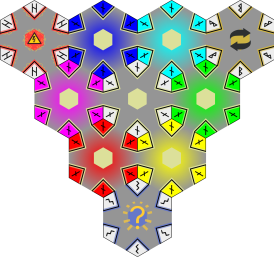
After tweaking and tuning for several days, I made changes that made the tiles considerably better;
- I added a shadow on the edges, to more clearly split the tiles
- I dimmed the color saturation considerably
- I moved the runes from the corners where they were hard to see, to the middle where they were obvious.
- I changed the runes to be different per colored area, rather than type of tile
- I removed the runes from the special tiles, and increased the size, contrast and clarity of the icons on them, to make them clearly visible at a distance.
These five steps turned the tiles I’d been working on from ‘barely passable eyesore’ to ‘good’. Not great, not amazing, but ‘good’. It also gave our game a stronger visual identity. All this iteration and trying and failing really hammered in the concept of ‘clarity of purpose’ for the special tiles as well. Early variations had the walls too ambiguous and had people wondering why they couldn’t step on them. People couldn’t actually tell that the negative tiles were negative. Having players learn which tiles were bad and good by trying and failing might be a good design for a more sadistic board game, but not ours.
.png)
.png)
.png)
.png)
.png)
.png)
.png)
.png)
.png)
.png)


.png)

.png)
 Folio and Foliage