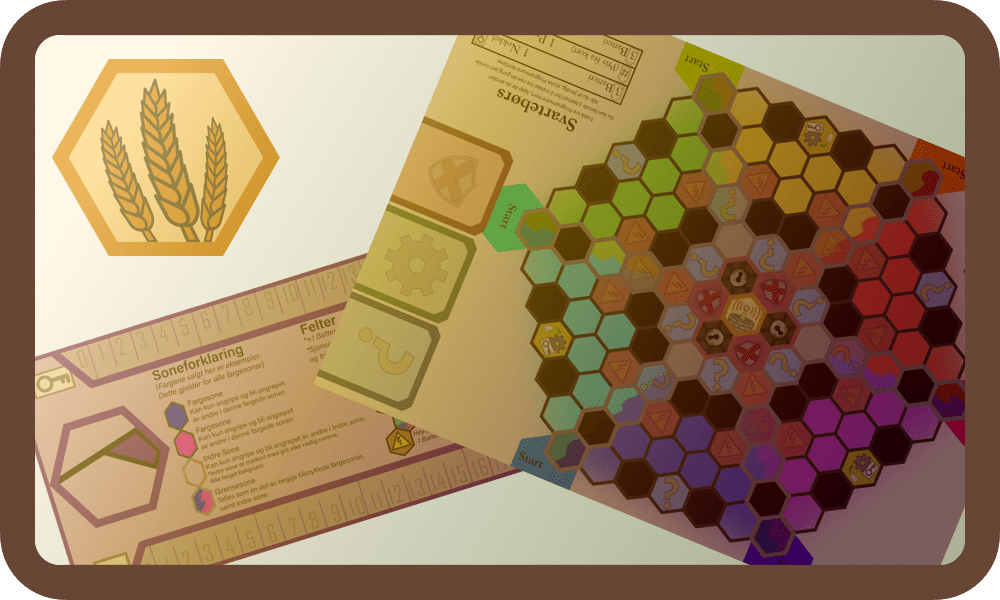
During work training, we made a board game.
Today, I’ll be walking you through the design process of this board game, from start to end, the process, what I learned, and what we could’ve done differently. I’m not going to go over the rules, as that’s kind of secondary to what I want to talk about.
We started with brainstorming ideas. At this point, we were one big group of people planning this project. 42 post-it notes went up on a board with different ideas, from things as vague as ‘NPCs’ and ‘Combat’ to more concrete ideas like ‘Based on Norwegian folk tales’ or ‘Hidden identity’.
The final ‘theme’ we decided to at least have as a starting point was Norwegian Folk Tales, specifically we talked about one called “Prinsessen som ingen kunne målbinde” or “The princess no-one could silence”, a tale about a boy who picks up any random garbage he finds on the road, and uses it to charm/flabbergast ‘the princess’. We also added the idea that this would be a more modernized version of this (for example, ‘The Princess No-one Could Short-Circuit’).
Along with this, we had the following project framework;
- The game had to be in Norwegian
- The game had to have well-described rules, and be playable without verbal explanation from the designers
- The game had to be playable by a couple of weeks after easter.
We then split off into two groups, working on two different board games. Our group started off with four people, reduced to three later, with me being team leader and artist.
We lost the theme a bit not long into the planning phase.
“You need to collect x amount of random items to get to the goal”
\|/
“We have a general currency to represent those random items”
\|/
“We’ll call them keys because that’s a bit quicker to understand”
Suddenly half the theme was gone. The working title at this point became “The Queen-Code Heist”, because we’d missed the fact that the game was supposed to be in Norwegian at this point.
.png)
After a week or two of back and forth, we had a prototype board. Hex grid, six players, chance and special fields, and a lock field to get into the centre. The rules, at this point, weren’t clear. During our presentation of that week’s progress, we ad-libbed a couple of the rules because we hadn’t planned out all the details yet. Our chance cards were post-it notes with the glue bit cut off. We had about three conflicting ideas of what the ! fields were supposed to do. It was a mess.
.png)


Over the next few weeks, the game board changed dramatically.
- Starting tiles were now outside the board
- No more ! spots
- Added walls to route navigation more
- Added special chance fields to get to the middle as an alternative to the lock
- Added and updated icons
- Added a shop where you could by item cards and keys using charges (later batteries), a currency you passively gained by walking around the board
- Added (and later removed) descriptions of each tile type
- Introduced zones, indicated by colours, which only allow negative effects to and from other players within the same zone
At this point, we had a game. A fully playable game, even. What was left was mainly polishing what we had.
Step 1; Updating the cards
.png)
The cards weren’t anything too fancy – they were made in Google Sheets with some icons for the type and colours on the backs for the three different types of cards we had. It worked, and that’s what mattered. The shop cards had prices printed on the back, we got them printed on cardboard so they weren’t just pieces of paper, and at that point they were done.
Step 2; Adjusting the theme
The name ‘Queen-Code Heist’ got thrown out when we switched to Norwegian. At that point, the only part of the theme we still had was that this was based on high-tech/cyberpunk. You weren’t an adventurer trying to short-circuit a princess, you were a hacker trying to get into a data vault. While we would’ve been fine going forward with that, we put our heads together and tried to re-imagine the theme.
Norwegian folk-tales
\|/
Norwegian fables
\|/
Norse mythology
Hitting that point, the ideas started cascading. Suddenly, the player’s a hacker cyber-viking representing a norse god. The zones could be branches of Yggdrasil. The datavault in the middle, a hypothetical database of all information, became the Mimir Code, based on the well belonging to the god Mimir in old norse faiths. The god is said to be the wisest being in the world, and the well is where Odin’s missing eye was thrown into.
Step 2.5; Character cards
Displaying this theme on the game board was difficult, so we merged this idea with the issue we had with space on the board and difficulty of keeping track of keys and batteries, and created player cards, or character cards.
Each of the six cards I made consisted of an icon based on a norse god (the three on this page are Tor (hammer), Balder (mistletoe) and Frøya (barley grain – fertility)), trackers for batteries and keys, and explanations of the tiles and zones. The physical versions would also have paperclips on the top and bottom to track currencies.


.png)
Step 3; Printing the pieces

A friend kindly volunteered his 3D printer to let us print out some physical tokens for the game board, a few days before we were supposed to have the entire thing done. The icons are the same ones used on the player cards, for ease of representation.
Step 4; Finalizing the board
.png)
The icons were updated. The board was redesigned with clearer colours and more faded icons. The tile explanations were off the board. The game was done. The project had run from the 26th of January to the 30th of March, two months of work, and we had a playable board game that wasn’t too long, and was even described by some as fun!
I wouldn’t know as I never got the time to play it myself, and I was taking notes during the test runs I was present for.
During this project we worked tightly in a small team, and we quickly picked up on how important communication is when working on a project like this, where everyone has their tasks. Setting up meetings, checking in on team members, this all contributed to our ‘success’. Two things come to mind for what we should have done from the start;
- Integrated the themes more into the gameplay and the game board
- Actually decided on the first draft of the rules from the start, as the fact that we weren’t consistent among each other on some of the rules meant that there were a lot of threads that needed to be picked up along the way. Some of them we only managed to catch in the last week before the deadline.
Working with a strict deadline on a project with a small team takes a different type of teamwork and discipline from a larger, more long-term project. You have less time to react if someone’s lagging behind and not communicating that they’re having issues before those problems start to domino into a bigger problem. On the other hand, with a smaller team it’s easier to keep track of who’s on the team, what their tasks are, and check in on them. On a team of a hundred people working on a two-year long project, one person not getting anything done for a week doesn’t usually bring the entire project to a halt.
On that note, we’ll end this post here. Next I’ll be digging into the next project – Digitizing this board game.
 Folio and Foliage